Welcome to Default to YES! Podcast
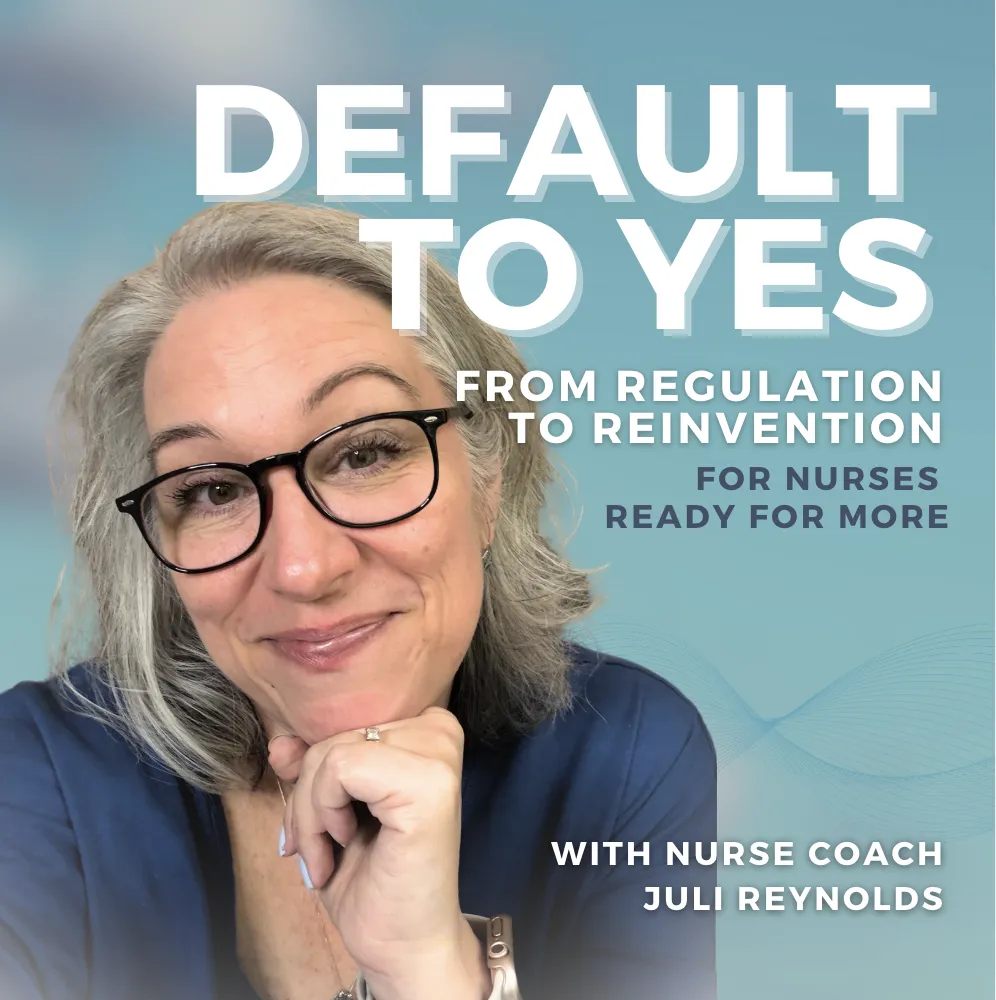
weekly coaching session for Nurses ready for more.
More clarity. More confidence. More capacity.
More freedom to move from regulation to reinvention—without losing yourself in the process.
SUBSCRIBE & NEVER MISS AN EPISODE!
OR GET ON THE LIST - I'll send you every episode along with all the bonus material!!








If you’re ready to move beyond surviving and start
saying YES—to your calling, to your health, and to your extraordinary self— If you are ready to train your brain
to cooperate with you - so you can get your goals and live a life that you love - this is for you!!
I'm Juli Reynolds, Board Certified Nurse Coach and Clinically Certified Aromatherapist Juli Reynolds, this podcast blends neuroscience, holistic health, and soul-centered coaching for leaders and high performers rise above burnout, navigate transitions, and live the life they were created for.
Each episode is approximately 20 minutes of:
Science-backed strategies for brain health, resilience, and well-being
Holistic practices like aromatherapy, breathwork, and lifestyle medicine
Stories & coaching questions that spark courage, confidence, and clarity in your daily life*

Blog
Default to Yes! Your Extraordinary Self

You Don’t Need Fixing: The Power of Becoming a Compassionate Observer
There’s a moment I’ve learned to recognize in myself—and once you notice it, you start seeing it everywhere.
Something small happens.
An email lands the wrong way.
A comment hits a nerve.
A memory surfaces without warning.
And before you’ve had time to think, your body has already decided.
Your chest tightens.
Your jaw clenches.
Your mind starts constructing a story—fast.
You’re no longer responding to what’s happening now.
You’re responding to what it reminds you of.
In that moment, you don’t just have an experience.
You become the experience.
For years, I believed the work was fixing that reaction—calming it, correcting it, overriding it with logic or faith or discipline.
What actually changed everything was learning how to observe it without turning on myself.
Why Awareness Alone Isn’t Enough
Most people are already self-aware.
They know when they’re anxious.
They know when they’re overwhelmed.
They know when something feels “off.”
But awareness without compassion often turns into self-criticism.
From a CBT (Cognitive Behavioral Therapy) perspective, this is where things go sideways. CBT teaches us that thoughts, emotions, and behaviors are interconnected—but it also emphasizes distancing from thoughts rather than fusing with them.
A thought like “I’m failing” is not the same as a fact.
But when we’re emotionally activated, the brain treats it like one.
Neuroscience explains why.
When the nervous system perceives threat—real or remembered—the amygdala activates rapidly. Blood flow shifts away from the prefrontal cortex (the part of the brain responsible for reasoning, perspective, and regulation) and toward survival circuits.
In other words:
You lose access to your wisest self at the exact moment you need it most.
Judgment doesn’t bring you back online.
Compassion does.
A Story of Noticing Instead of Fixing
I remember a moment when my body reacted with intense urgency in a situation that didn’t logically warrant it.
Nothing dramatic was happening. I was safe. I was capable.
But my body told a different story.
My breath shortened.
My muscles tightened.
My thoughts rushed toward do something—now.
In the past, I would have immediately tried to fix that reaction—talk myself out of it, spiritualize it, or push through. I really hate it when other people try to talk me out of an animated reaction, why would I take it well from myself? Don't tell ME to CALM DOWN!
So - This time, I paused.
Internally, I said:
Oh. This is happening.
No judgment.
No analysis.
No attempt to make it stop.
And something surprising happened.
The intensity softened.
Not because the reaction was wrong—but because it was finally being witnessed without threat.
From a neuroscience standpoint, that pause re-engaged my prefrontal cortex. From a CBT standpoint, I created distance between me and the thought-emotion loop.
From a human standpoint, I stopped abandoning myself.
(And part of me wondered, if someone else said to me "this is happening, so now what?" instead of "it's no big deal" or "calm down" "it'll be fine" - which are all fighting words in my book....how would that be?)
Compassionate Observation: The Skill That Changes Everything
Being a compassionate observer means you can:
notice thoughts without assuming they’re true
feel emotions without letting them take over
sense body responses without shaming them
CBT calls this cognitive defusion—the ability to see thoughts as mental events rather than commands.
Neuroscience calls it top-down regulation—using awareness and meaning-making to calm lower brain centers.
Scripture calls it stillness.
“Be still, and know that I am God.” —Psalm 46:10
Stillness is not avoidance.
It’s presence without panic.
Thought Downloads: A Science-Backed Regulation Tool
One of the simplest, most effective ways to practice compassionate observation is through a thought download.
A thought download is not insight journaling.
It’s not gratitude practice.
It’s not positive reframing.
It’s externalization.
You write down everything your mind is saying—uncensored, repetitive, sometimes uncomfortable.
Why it works (science-backed):
Writing reduces cognitive load and mental looping
Naming thoughts decreases amygdala activation
Externalizing thoughts increases cognitive flexibility
In CBT terms, you move from thought fusion to thought observation.
In nervous system terms, you create safety through clarity.
You’re no longer trapped inside the storm.
You’re watching it from solid ground.
Journaling as Nervous System Care, Not Performance
Many people abandon journaling because they think they’re doing it wrong.
But journaling isn’t about insight—it’s about integration.
Compassionate journaling sounds like:
Of course this feels heavy—this has been a lot.
It makes sense that my body reacted.
I don’t need answers yet.
That tone alone can reduce stress hormones and signal safety to the nervous system.
“The Lord is near to the brokenhearted.” —Psalm 34:18
Nearness—not urgency—is what heals.
From Self-Criticism to Self-Leadership
Here’s the shift that changes everything.
Instead of asking:
What’s wrong with me?
You ask:
What’s happening in me?
That single question moves you:
from judgment to curiosity
from reaction to response
from self-attack to self-leadership
As many thought leaders in psychology and coaching emphasize:
Awareness without compassion is just another form of pressure.
And pressure has never been a sustainable path to healing.
You Don’t Need Fixing—You Need Safety
Growth doesn’t begin with fixing.
Healing doesn’t begin with force.
Both begin with safety.
And safety begins the moment you feel allowed to notice your inner world without being punished for it.
You are not broken.
You are responding.
And you can learn to observe your thoughts, emotions, and body with compassion—one moment at a time.
That is not weakness.
That is wisdom.

Episode Resources and Freebies:
COMPANY
CUSTOMER CARE
NEWS
LEGAL


© Copyright 2026. Reimagine Wellness. All Rights Reserved.