
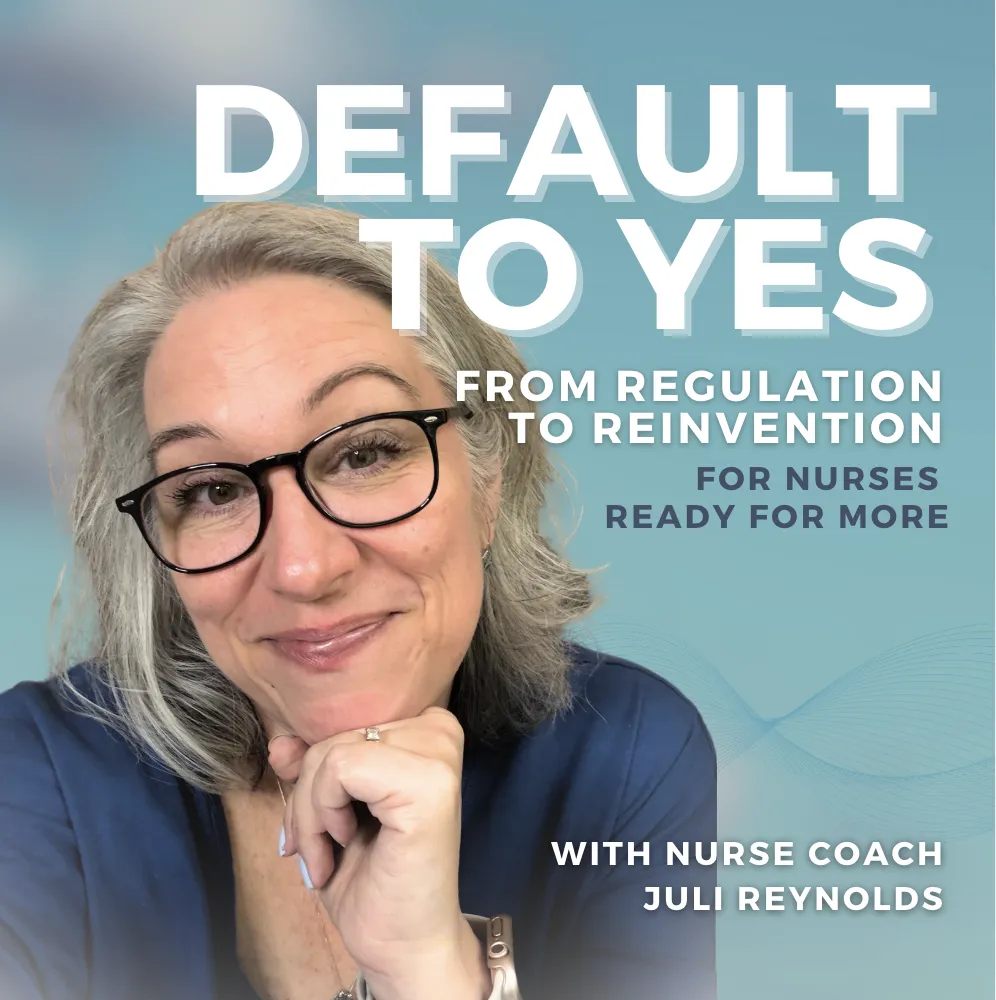
Welcome to Default to YES! Podcast
weekly coaching session for Nurses ready for more.
More clarity. More confidence. More capacity.
More freedom to move from regulation to reinvention—without losing yourself in the process.
SUBSCRIBE & NEVER MISS AN EPISODE!
OR GET ON THE LIST - I'll send you every episode along with all the bonus material!!








If you’re ready to move beyond surviving and start
saying YES—to your calling, to your health, and to your extraordinary self— If you are ready to train your brain
to cooperate with you - so you can get your goals and live a life that you love - this is for you!!
I'm Juli Reynolds, Board Certified Nurse Coach and Clinically Certified Aromatherapist Juli Reynolds, this podcast blends neuroscience, holistic health, and soul-centered coaching for leaders and high performers rise above burnout, navigate transitions, and live the life they were created for.
Each episode is approximately 20 minutes of:
Science-backed strategies for brain health, resilience, and well-being
Holistic practices like aromatherapy, breathwork, and lifestyle medicine
Stories & coaching questions that spark courage, confidence, and clarity in your daily life*

Blog
Default to Yes! Your Extraordinary Self

Stop Waiting to Be Understood: The Lie About Self-Sacrifice
There’s a question that sounds supportive on the surface—but for many nurses, it lands with unexpected weight:
“What do you need right now?”
It’s a good question.
A well-intentioned one.
And yet, for so many nurses, it’s hard to answer.
Not because we don’t have needs—but because we’ve spent years (often decades) practicing something else entirely: scanning the room, anticipating others, filling gaps, and pushing through.
Many of us are far more skilled at knowing what everyone else needs than slowing down long enough to hear ourselves.
That difficulty isn’t a personal failing.
It’s a learned survival skill.
And it’s reinforced by a quiet but powerful lie nurses are taught early and often:
Self-sacrifice is what makes you a good nurse.
The Cost of Waiting to Be Understood
There’s a deep, understandable longing beneath this pattern.
We want leaders to know what we need.
We want our partners, families, and colleagues to see the load we’re carrying without us having to explain it.
We want the system to recognize the weight of the work and respond accordingly.
And sometimes that happens.
But often, it doesn’t.
When we wait to be understood—without clarity, without voice, without boundaries—we stay stuck. Not because we lack power, but because we’ve been conditioned to distrust it.
Waiting becomes quieter than asking.
Pushing becomes safer than naming needs.
Endurance becomes confused with excellence.
Over time, that costs us:
Nervous system overload
Moral distress
Emotional exhaustion
A sense of disconnection from our own voice
Not because we care too much—but because we’ve been taught that caring requires self-abandonment.
Self-Sacrifice Is Not the Same as Compassion
Let’s be clear: compassion is foundational to nursing.
But self-sacrifice is not a clinical requirement.
In fact, from a neuroscience and patient-safety standpoint, chronic self-sacrifice undermines care.
Nurses are regulators of nervous systems—patients’, families’, and entire units.
Through tone, pacing, presence, and judgment, nurses create safety signals that directly impact outcomes.
When a nurse is regulated:
Decision-making improves
Cognitive flexibility increases
Errors decrease
Communication becomes clearer
When a nurse is chronically depleted:
The system loses one of its most stabilizing forces
Boundaries are not selfish.
They are ethical.
Advocacy is not aggression.
It is professional responsibility.
And knowing what you need is not weakness—it’s a skill that supports safety, sustainability, and integrity.
Why “What Do You Need?” Feels So Hard to Answer
For many nurses, that question activates more than reflection—it activates the nervous system.
It can trigger:
Pressure to perform
Fear of asking for “too much”
Uncertainty about what’s even allowed
A lifetime of prioritizing others first
So instead of clarity, the body offers fog.
That’s not failure.
That’s a signal.
Before we can answer the question, we often need to regulate enough to hear the answer.
A Simple Practice to Rebuild Self-Trust
Before trying to respond to “What do you need right now?” try this:
Place one hand over your sternum and one over your lower ribs or belly.
Inhale slowly through your nose for a count of 4.
Exhale through your mouth for a count of 6.
Repeat for 3–5 rounds.
Then gently shift the question:
“What feels most supportive in this moment?”
You’re not looking for a perfect or permanent answer.
You’re practicing awareness.
This is how self-trust is rebuilt—not through force, but through listening.
Stepping Into Power Without Losing Humility
Here’s the reframe many nurses need:
Yes—leaders, systems, and partners should listen better.
Yes—there are real structural issues that must change.
And also:
Your clarity matters.
Knowing what you want.
Naming what you need.
Saying it clearly—to your boss, your coworker, your family, your spouse.
Not from anger.
Not from shutdown.
From grounded self-trust.
At the same time, power doesn’t require rigidity.
If we’re missing perspective, we stay open to learning.
Power and humility can coexist.
That’s regulation.
That’s leadership.
That’s nursing at its best.
You Don’t Have to Wait to Be Understood
You are not “just a nurse.”
You are a nervous-system regulator.
A safety signal.
A stabilizing force in complex systems.
And you don’t have to wait for someone else to fully understand you to begin honoring yourself.
Self-sacrifice has been mistaken for virtue for far too long.
It’s time to tell the truth.
Clarity is not selfish.
Boundaries are not betrayal.
Advocacy is not optional.
And when nurses stop waiting to be understood—and start trusting themselves to speak clearly and ethically?
Everything changes.
If this resonated, you can listen to the full podcast episode “Stop Waiting to Be Understood: The Lie Nurses Are Taught About Self-Sacrifice” and join the conversation with nurses who are ready for more clarity, confidence, and capacity.
You don’t have to do this alone.

Episode Resources and Freebies:
COMPANY
CUSTOMER CARE
NEWS
LEGAL



© Copyright 2026. Reimagine Wellness. All Rights Reserved.